
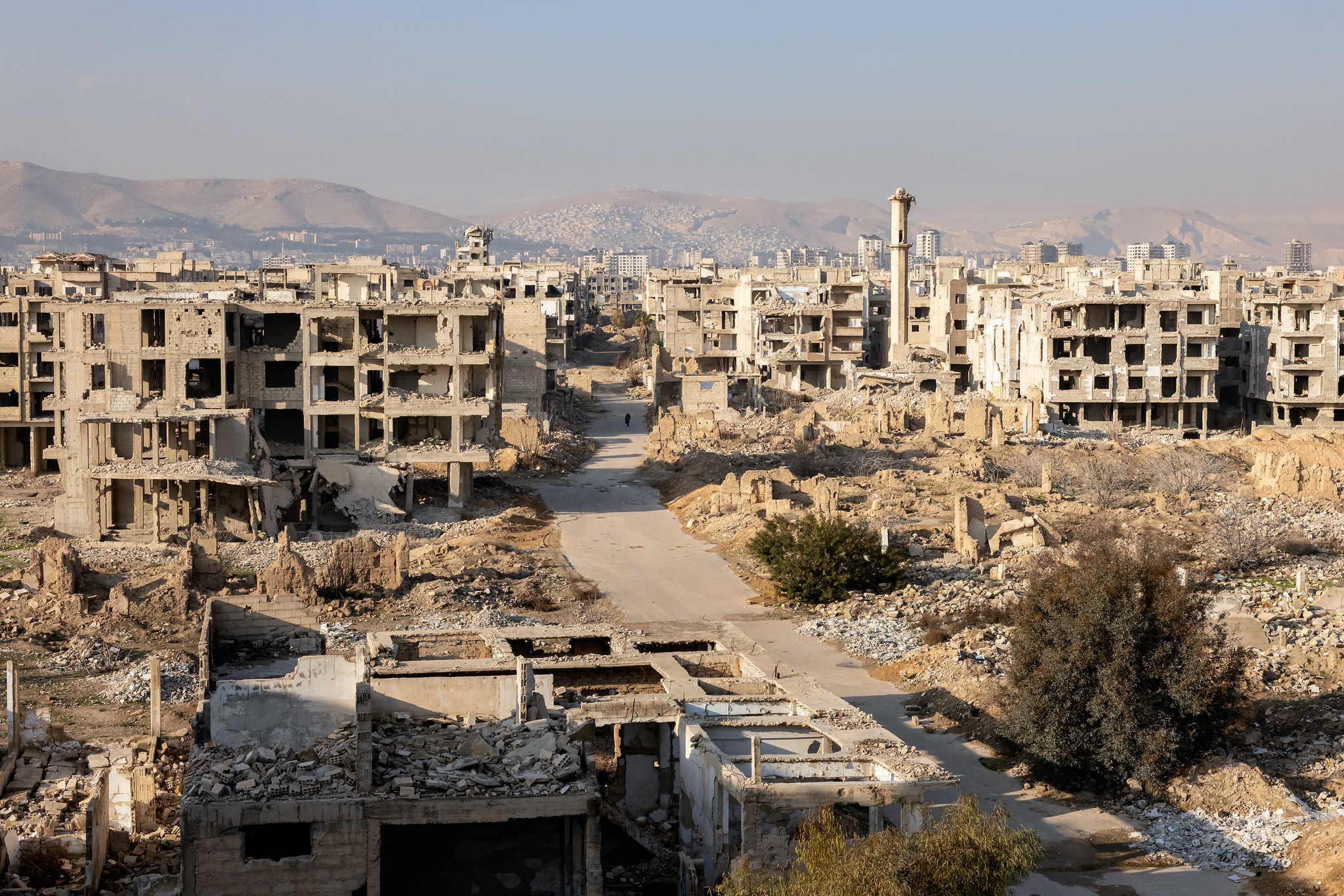
When the Assad regime rapidly fell in December 2024, Gareth Browne, reporting for The Economist, was one of the first Western journalists in Damascus in the wake of the rebel assault. Arriving at the headquarters of Assad’s security services, Browne opened a binder of documents from Branch 300 of Assad’s General Intelligence Directorate, photographing the contents with his cellphone camera. Journalists working for news publications, such as The Sunday Times, Washington Post, Wall Street Journal, and AFP similarly photographed and copied various collections of Assad regime paper and computer documents.
As decentralized as these historically valuable efforts have been, they suggest that intelligence sharing, including Assad regime documents, should be an area of engagement for Trump administration officials and Syria’s interim government. Records of recent events could help inform current policy in the Middle East. Within these records lies a fuller understanding the Islamic Republic of Iran’s longstanding alliance with the Assad regime and therefore possible answers for preventing the resurgence of Iranian influence in Syria despite the damage inflicted on Iran and its Axis of Resistance in the ongoing regional war well into its third year. Radicalism within the ranks of the Syrian Security Forces is a genuine challenge for Syria’s government and concern for US national security. However, with Syria having formally joined the coalition against the Islamic State and the last US troops having left the southern and eastern parts of the country, the Trump administration has made clear that it sees the government of Ahmed al-Sharaa in Damascus as its primary partner.
Beyond current policy issues, even the investigation of historical topics could offer a more complete understanding of the history of the Middle East’s geopolitics and the involvement of the United States, benefitting US national security in the process. Historical examples that remain relevant to ongoing policy include the exact nature and extent of the Assad regime’s support for the Islamic State-led insurgency against the 2003-2011 US occupation of neighboring Iraq, along with the charges of passive and active collaboration between Assad and the Islamic State during Syria’s post-2011 conflict. Assad regime records are a point of departure for discussing and demonstrating the wider value of adversary records in learning lessons from America’s wars in the Middle East, a region that successive presidential administrations have talked about “pivoting” away from to Asia, only to be drawn back into conflict.
Inside the Assad Regime’s Security Services
Browne’s documents, dated between April and September 2021, provided an overview of the General Intelligence Directorate’s activities during the period. The files in the binder Browne photographed deal with people who appear to have been investigated, cleared, and largely spared punishment by the Assad regime. The one notable exception was an investigation of three General Intelligence Directorate employees who conspired to extort a subject. Even in the comparatively benign cases, the regime deployed the full array of its security apparatus to document and detail the lives of Syrians and others inside the country and beyond its borders, employing every kind of surveillance at its disposal. The special purview of Branch 300 appears to have been Syrians living abroad who recently returned, those who previously traveled abroad extensively, had foreign connections, especially financial, of concern to the regime, were dual citizens, or foreign nationals. The branch also corresponded with Hezbollah’s Security Coordination and Liaison Office and monitored the activities of the Iranian Development and Construction Jihad Organization in Syria. Branch 300 seemingly watched all the regime’s friends as closely as its enemies. In one case, it conducted a thorough investigation of a Syrian bank employee who befriended an employee from the Russian embassy during a Christian pilgrimage trip both participated in. In another instance, a former General Security Directorate employee from the 1980s, who later worked as a presidential bodyguard in the Russian-backed Georgian breakaway republic of Abkhazia, was extensively questioned over Facebook posts associated with an old work cellphone number he briefly used more than a decade prior. Thus, beyond the role of Iran and its Hezbollah ally in Syria, Assad’s security services also closely monitored Russia’s presence and interests. And unlike Iran and Hezbollah, Russia’s formal military presence in Syria has remained despite the collapse of Assad’s regime.
The History and Public Policy Program, formerly at the Woodrow Wilson International Center for Scholars, was in the process of making these documents available to the interested public when the Department of Government Efficiency (DOGE) arrived during the first week of April 2025. Included in a March 14, 2025, Trump administration executive order for “Continuing the Reduction of the Federal Bureaucracy,” the Wilson Center was quickly reduced to its “minimum statutory requirement” by DOGE, leaving the numerous regional and thematic studies programs, funded primarily by private donors, to find new institutional homes or independent arrangements. Aside from being part of an overall increase in federal spending, DOGE and its approach revealed a very narrow understanding of “efficiency.” As opposed to simply laying people off, a much wider grasp of efficiency could be employing scholars and permitting the interested public to study Syrian, Iraqi, Islamic State, or al-Qaeda records in an effort to learn lessons from past conflicts and shape policy in way that affords the best chance of avoiding costly future unnecessary conflicts while prosecuting only those that are necessary.
The Assad regime documents, carefully redacted for Personally Identifiable Information (PII) and translated into English, would have been added to the History and Public Policy Program’s Digital Archive, joining thousands of other pages of translated formerly classified documents in what is a leading resource for scholars of international history. The Assad Files project, intended to be the first of many releases, with a The Times collection of documents as the planned second installment, was modelled on the Wilson Center’s Saddam Files partnership with Pulitzer Prize-winning journalist Steve Coll, which released several thousand pages of original Iraqi documents, audio tape transcriptions, and English translations between 2024 and 2025. At the time of the executive order, the History and Public Policy Program staff was also working to release additional Iraqi records, including the audio files of Saddam’s meetings. Along with interest from researchers in the United States and around the world, the project was closely followed by members of the Homeland Security Investigations-led Human Rights Violators and War Crimes Center, veterans of the intelligence community, and several other US government agencies.
In light of the sudden termination of all these efforts by DOGE, the Department of Defense should step in and support the study of adversary and conflict records, both as a public service and due to their value in fostering greater understanding of the Middle East, a region in which the United States military remains deeply embedded. The ongoing conflict and standoff with Iran is a case in point that has combined aspects of and themes from the 1980-1988 Iran-Iraq War, 1990-1991 Gulf War, confrontations between Saddam’s regime and the United States between 1991 and 2003, along with the 2003 Iraq War. Policymakers today have ignored lessons from these conflicts at their own peril, resulting in a current predicament that mirrors aspects of the challenges that faced Saddam and successive US presidential administrations that dealt with Iran and Iraq as policy issues between the 1980s and 2003.
Conflicts and Adversary Archives
Beginning with the 1846-1848 Mexican-American War, the US federal government has generally taken an interest in seizing adversary archives in accordance with the laws of war, along with fostering efforts for their study. The most prominent twentieth century example in this regard was World War II and the archives of the defeated Axis powers. The prosecution of the Third Reich’s leadership during the Nuremberg Trials drew upon nearly 750,000 pages of documents, which remain crucial historical sources, especially for the logistics and planning of Nazi crimes. Today, the interest of the Justice and Homeland Security departments in Iraqi and Syrian documents for pursuing human rights violators and war criminals, along with the opening of the first trials of former Assad regime officials in Damascus, underscore the importance of preserving and utilizing documentary evidence.
During greater direct involvement in the Middle East around the turn of the millennium, the US military seized vast quantities of official documents from Iraq in 1991 and 2003. The Bush administration’s Global War on Terror and the fight against al-Qaeda and affiliated groups resulted in the seizure of records as well, involving arguably greater detective work on the part of the US military and intelligence community in mapping the institutions of these non-state actors, which often resembled states. For a brief period between 2010 and 2015, as an extension of Secretary of Defense Robert Gates’s Minerva Initiative, the Pentagon supported the study of Iraqi and al-Qaeda records at the Conflict Records Research Center (CRRC), which was housed in a small office at the National Defense University. The digital copies of the files were derived from the Pentagon’s Harmony Database. The Combatting Terrorism Center at West Point undertook similar efforts to study and release al-Qaeda in Iraq records from the Harmony Database and remains a capable internal partner should the Pentagon renew support for such efforts.
By 2015, the turnover of personnel, funding cuts, and shifting priorities left the official Pentagon sponsorship of research using captured records to languish. Subsequent initiatives, while valuable, have generally been either ad hoc or limited in scope.
In November 2017, the Central Intelligence Agency (CIA) under the first Trump administration released the Abbottabad records, some 470,000 files captured during the May 2011 raid that killed al-Qaeda leader Usama Bin Laden. The records yielded valuable insights into al-Qaeda’s relationship with Iran, along with permitting the first academic works on the organization and Bin Laden based primarily on internal sources. The CIA website records portal stands as a testament to transparency and open access, which can be replicated with other collections. Furthermore, the mass release of Bin Laden files stood in sharp contrast to the previous incremental releases under the Obama administration, which critics underscored as both belated and incomplete.
The second Trump administration has demonstrated its positive disposition to the mass release of previously classified historical records on the internet, quickly following through on a repeated campaign pledge to make available the remaining JFK Assassination records. Although imperfect and in some cases releasing records that were declassified long ago, other topics that have received the mass release of documents by the second Trump administration include the Martin Luther King Jr. and Robert F. Kennedy assassinations, the unsolved mystery of Amelia Earhart’s final flight, and Pentagon records related to UFOs. While the saga of the Epstein files and their botched release may have soured some officials on the release of large volumes of documents, it is an opportune time to renew the interest shown by the first Trump administration in releasing documents from America’s wars in the Middle East. Similar to these other document releases, the Office of the Director of National Intelligence (ODNI) support for the project would be crucial.
By the time the second Trump administration took office in January 2025, the United States was deeply involved in the region-wide war that followed the October 7, 2023, attack on Israel by Hamas. In addition to striking Iran’s nuclear program during the 2025 Twelve-Day War, the 2026 Iran War has once again dramatically expanded direct US military involvement in the Middle East. Records related to the various stages of US participation in Middle East conflict stretching back nearly half a century are timelier than ever. The Biden administration took modest action on this issue that should inform larger follow-up efforts today by the second Trump administration.
The Conflict Records Research Center, Hoover Institution, and Harmony Database
In 2022, the Biden administration Pentagon sent a partially recovered copy of Iraqi records from the former CRRC archive to Steve Coll and Reporters Committee for Freedom of the Press, which had represented him in a Freedom of Information Act lawsuit. The following year, based on and facilitated by the previous deal with Coll, the Biden administration Pentagon agreed to share a more complete CRRC archive, including both Saddam regime and al-Qaeda records, with the Hoover Institution Library and Archives. Although a positive development and a major service to academic and US government researchers, Hoover tightly controls access, requiring researchers to view records in-person on computers at its Stanford University and Washington, D.C. locations.
Hoover’s policies remain in place even though the Iraqi Baʿth Party Archive and the original records on which the Harmony Database and CRRC archive were based, were both repatriated to Iraq by the Pentagon in 2020 and 2013, respectively. The former collection was accompanied by a digital copy, which was followed by a second copy when both the original records and first digital copy went missing in Iraq. Meanwhile, researchers at Hoover can request copies of a limited number of English translations of Iraqi and al-Qaeda CRRC records, sources that were long ago prepared by contractor and employee linguists working on behalf of the US federal government, in exchange for paying Hoover $20 per PDF file. Many of the same records were released for free on the internet by the History and Public Policy Program, without issue.
Concerns about protecting privacy by tightly controlling access to researchers in the United States were long ago overtaken by events with the return of original records and digital copies to Iraq, where Iran and its allies often control or otherwise ride roughshod over the state’s institutions and political leaders. In terms of inhibiting the full potential for research, restricting access to on-site only in the United States prevents research at scale, to say nothing of utilizing Large Language Model (LLM) analysis, which digitized records easily lend themselves to.
Such restrictive policies stand in contrast to the spirit of open access that characterized the first Trump administration’s release of Bin Laden’s Abbottabad files, both in the original Arabic and English translations that accompanied many, along with the more recent release of the JFK, RFK, and MLK assassination records, and UFO files by the second Trump administration. Similarly, the work of the History and Public Policy Program was animated by a commitment to making Iraqi and Syrian records available to the interested public and academic researchers alike, which is the best means for maximizing the lessons learned from the past, informing sound policy in the present, and enhancing US national security for the future as well.
Today, this approach can efficiently be directed towards the mass release of Iraqi records from the Pentagon’s Harmony Database, from which the CRRC was a small subset, along with helping coordinate between journalists, Non-Governmental Organizations, and Syria’s interim government to preserve Assad regime archives for intelligence sharing and transitional justice efforts in the present, along with future academic research, similar to the Nuremberg Files. With respect to the Iraqi records, an easy first step for the ODNI or the Office of the Undersecretary of Defense for Policy (OUSDP) would be releasing a document on file at the Joint History and Research Office titled “The Saddam Tapes Harmony Media Files Screening Results.” This index, 584 pages long and labelled with the antiquated For Official Use Only (FOUO) designation from 2008, lists an additional 1,800 hours of Saddam’s audio tapes that were screened and cleared to join the roughly 200 hours of tapes included in the CRRC archive. However, Pentagon funding for the project dried up before the transfer took place. Along with releasing the index, the Pentagon should release the audio files themselves online, using the 2017 Abbottabad Files release as its guiding example. Alternatively, if in need of an internal Department of Defense academic partner for such a project, the Combatting Terrorism Center at West Point has experience working with, studying, and releasing Harmony Database records going back nearly two decades.
Conclusion: America and the Middle East Through the Eyes of Bin Laden, Saddam, ISIS, and Assad
Alongside the 2017 Abbottabad Files release, the previous work of the History and Public Policy Program provides an enduring template for making previously classified records, both from the United States and foreign countries, available to the widest possible audience in the hope of both rapidly updating policy and global historical understanding. Even during the program’s ongoing relocation to the University of Maryland College Park, its Saddam and Assad Files projects should inform Trump administration policy with respect to collections it can either release immediately in the case of Iraq or facilitate the creation of through constructive engagement in Syria. Similar possibilities exist for the release of additional captured records from al-Qaeda, along with the Islamic State.
In addition to the immediate utility of insights into enduring threats to US interests in the Middle East from Iran and its allies, expanding access to and facilitating research using the records from Saddam and Assad’s regimes can provide a better understanding of US foreign policy and involvement in both countries and the wider region over the last several decades. Despite so many claims to the contrary and the prior relocation of US military forces away from the Middle East, US military involvement in the region will not be winding down any time soon.
Michael Brill is a Ph.D. Candidate in the Department of Near Eastern Studies at Princeton University. In 2024-2025, he was a Global Fellow in the History and Public Policy Program at the Woodrow Wilson International Center for Scholars and a Non-Resident Fellow at the Institute for Future Conflict. The views expressed in this piece are those of the author and do not reflect the official policy or position of the US Air Force, the US Department of Defense, or the US government.