

Upheaval in the Heavens: Fighting in Low Earth Orbit
In Navajo lore, the Milky Way came about when the trickster god Coyote—tired of waiting for the Black God to place stars one by one—took the blanket holding all the remaining stars and tossed it into the sky. SpaceX served as the Coyote of the second space age. Starlink is just the first of many proliferated low earth orbit (pLEO) constellations replacing the exquisite satellites America spent decades building. SpaceX scattered the stars. The US Department of Defense still targets them one by one.
Upheaval of the Heavens
The United States has enjoyed preeminence in space for decades, and the joint force has come to rely on the information superiority granted by space-based assets. USSPACECOM’s self-declared mission to “ensure there is never a day without space” touches on everything from precision navigation to missile warning, and from satellite communication to overhead targeting. Such integration has enabled major advantages in modern conflicts like the Gulf War, Operation Iraqi Freedom, and ongoing global counterterrorism operations.
But the days of the US government having a near-monopoly on those advantages are over. SpaceX alone operates over 9,000 satellites in low earth orbit (LEO), with plans for over 42,000 total. The United Kingdom-based company OneWeb established global coverage with their constellation in 2023, and Amazon’s Project LEO has put their first 150 satellites in orbit. China has announced two separate pLEO mega-constellations, Guowang and G60 “Thousand Sails.” Meanwhile, the US government has invested in at least three separate pLEO constellations on top of its Starlink usage: Starshield, Viasat, and the Proliferated Warfighter Space Architecture.
Current pLEO constellations have already demonstrated their usefulness to warfighting. The Starlink constellation has enabled Ukraine—a nation with no space-based assets of its own—to use on-orbit capabilities for a wide range of tasks. These include command and control, drone piloting, artillery targeting, air defense coordination, and information operations. Given the critical nature of Starlink to the Ukrainian military, why has Russia—a capable space actor in its own right—failed to curtail Ukraine’s use of space over two years of war? Primarily because it can’t.
Legacy anti-satellite (ASAT) technology is not suited to countering a pLEO constellation. Most ASATs were designed to target a small number of systems in high orbits, which come with their own unique set of challenges. A pLEO constellation, however, flips many of those challenges. Countering adversary pLEO constellations has four significant hurdles to overcome, none of which current US ASAT capabilities address.
Hurdle 1: Narrow Beams, Narrow Windows
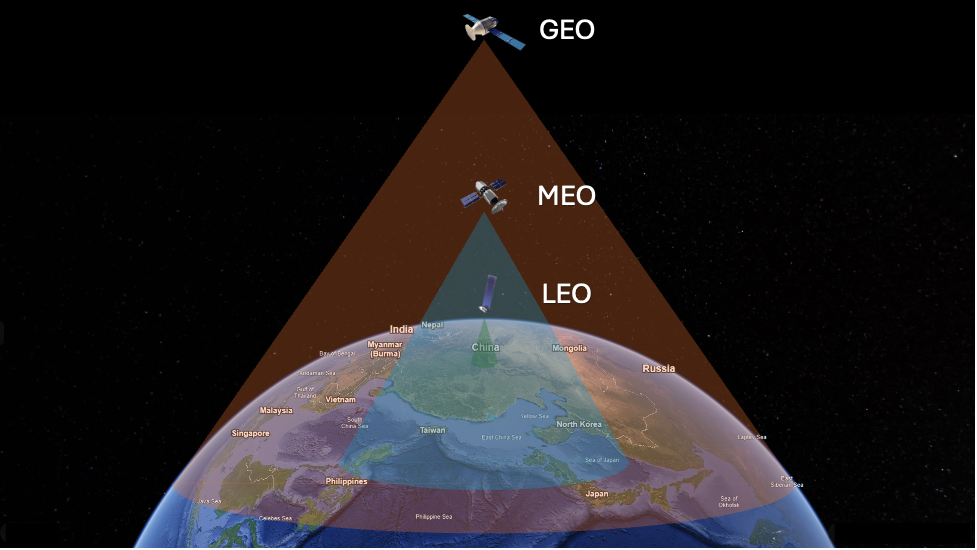
Every satellite requires line of sight to effectively operate. Historically, providers have taken advantage of geostationary (GEO) and medium earth (MEO) orbits to provide service given their vast lines of sight over the globe. Those orbits allow for single-digit or low double-digit constellations to provide global coverage. But operating at an orbit high enough to reach a large swath of the globe means line of sight to that entire area, giving ASATs a wider range for employment. After all, a satellite in GEO that can service half the globe can also be identified from half the globe.
Targeting pLEO constellations offers the exact opposite challenge. Instead of a few satellites servicing wide ranges, thousands of satellites cover far smaller areas. This is less efficient but is also significantly harder to target due to the narrow beams LEO satellites utilize. Consider the following graphic. While not to scale, it gives a sense of how an attacker has more options when targeting GEO and MEO satellites compared to LEO:
Hurdle 2: Sixteen Jammers, Six Thousand Satellites
Assuming line of sight limitations can be overcome, engaging the satellite becomes the next hurdle. Targeting a single satellite is hard. It requires equipment positioned in the right place capable of producing the right amount of power, and the right intelligence to ensure that it has the desired effect. Targeting a pLEO takes that problem and increases it by orders of magnitude, all while each individual satellite passes overhead in minutes.
Depending on how a pLEO constellation prioritizes coverage areas, multiple satellites will operate in view of a ground receiver at any given time. Disrupting one satellite just means the ground receiver rolls over to a different one. Any effort to target a pLEO constellation requires meeting mass with mass.
Unfortunately, the United States lacks ASAT mass. For example, the number of the US Space Force’s premiere jamming system—the Counter Communications System (CCS)—tops out at 16 total. The CCS is an effective weapon when used against its preferred targets, but against a pLEO constellation, it would be akin to taking down individual gnats with a cruise missile. While the soon-to-be deployed Remote Modular Terminals and the Meadowlands follow-on to the CCS are a step in the right direction, they likely suffer from many of the same limitations against mass targets.
Hurdle 3: Kill 99%, Lose Anyway
On-orbit links are a second reason why current ASAT numbers are too low to deal with pLEO constellations. Satellites no longer just talk up and down, but side to side, as well. Even if the United States managed to disrupt 99% of an adversary’s pLEO constellation over the target area, that remaining 1% will ensure that any ground-to-orbit connection can reach its intended recipient through on-orbit connections. Granted, this would still result in massively degraded service, but with observed latency and data rates from today’s pLEO satellites, a well-designed network with automated prioritization would still be able to pass along crucial information, such as targeting data or nuclear command and control.
This is not a theoretical technology, either. SpaceX has perfected laser links between its satellites to such a degree that not only can those links rapidly convey hundreds of gigabytes of data completely on-orbit, but they are now confident enough in the technology to market it to others as a “plug and play” capability. The assumption should be that any adversary pLEO constellation would launch with the same capability, further complicating counterspace operations.
Hurdle 4: The Only Way to Win Is Not to Play
Four nations have succeeded in demonstrating the ability to kinetically kill satellites in orbit: the United States, Russia, China, and India. For their efforts, these countries possess one of the only weapons that can rival a nuclear weapon in relative uselessness beyond deterrence. While kinetic strikes on satellites and orbital vessels may yield short term success, they would cause a global disaster that could curtail space activity for all countries, potentially for centuries.
This problem is known as Kessler Syndrome. The physical destruction of a few satellites would kickstart a cascading effect where debris from one satellite destroys others, and the debris from those in turn goes on to destroy still more. A Kessler Syndrome outcome can damage or destroy anything else in orbit—including friendly satellites. In 2007, China conducted a kinetic direct-ascent ASAT test against one of their own satellites. Both the missile and the satellite were completely destroyed by the impact, releasing an estimated 35,000 pieces of debris, 32,000 of which remain untracked. It was the largest debris cloud ever created by a single event, with 79% of the debris expected to remain in orbit well into the next century. The debris cloud has proven an obstacle for satellites to maneuver around ever since.
There are ways to strike satellites kinetically to reduce debris, but once again the issue of mass comes to the forefront. Our world’s orbits might survive a few such strikes. Almost by definition of terms, one nation’s attack on a pLEO constellation will have to be large and widespread. As mentioned above, only destroying a few pLEO satellites in a constellation would have a negligible effect. If a nation were to use kinetic means, they would have to launch a full barrage—all but guaranteeing a Kessler cascade. If kinetic action is taken, it would have to be overwhelming, all but guaranteeing a Kessler Syndrome outcome.
Rethinking Space Superiority – Again
While defense professionals recognize the halcyon days of unchallenged American space superiority have passed, pLEO requires further changes in thinking. Much like how air professionals are coming to acknowledge air superiority may only come in brief waves in a peer conflict, so too must the joint force recognize space superiority will come episodically, if at all.
Chief of Space Operations General Chance Salzman says space superiority must include protecting the joint force from space-enabled attack. Unfortunately, the Space Force will be hard-pressed to do so in a battlespace filled with pLEO constellations. This problem goes beyond communication satellites. While Starlink gets the bulk of news coverage, other LEO capabilities exist on orbit, as well: Planet Labs operates a constellation of over 200 imagery satellites in LEO, some capable of 50 cm resolution, and the Space Force’s Proliferated Warfighter Space Architecture maintains missile warning as one of its core missions. Fully denying an adversary with multiple pLEO constellations capable of different mission sets will prove a tall order, potentially beyond the reach of even the most capable military.
The four hurdles outlined here—line of sight limitations, overwhelming target numbers, on-orbit redundancy, and the Kessler Syndrome risk—represent more than technical challenges. They represent the collapse of foundational assumptions about American military operations. For over four decades, the joint force has planned around having a virtual monopoly on space-based ISR, communications, and precision navigation. Those plans no longer hold.
SpaceX and other coyotes have already tossed the blanket. Now the United States must see if it can navigate by these new stars or if it will continue mapping the old constellations. Solutions exist, but they require accepting uncomfortable realities about the future of warfare. The question facing defense planners isn’t whether pLEO constellations can be countered—it’s whether the United States can think fast enough to make a difference.
Major R. Jake Alleman is an Intermediate Level Education (ILE) Fellow at the Institute for Future Conflict at the US Air Force Academy.
The views expressed are those of the author and do not reflect the official policy or position of the US Space Force, Defense Department, or the US government.